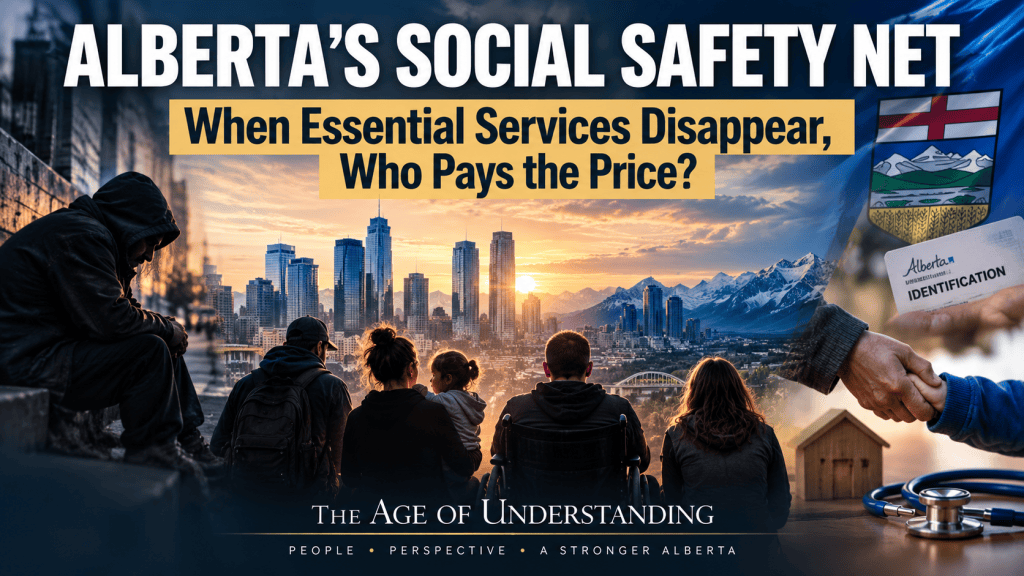
From addiction recovery and homelessness prevention to disability benefits, autism services, and community support, Alberta’s social safety net is undergoing significant changes. But what happens to vulnerable Albertans when essential services are reduced, replaced, or eliminated?
The Age of Understanding | October 2026
A Province Is More Than Its Economy
Alberta is a province rich in natural resources, economic opportunity, and human potential. But the measure of a province’s success cannot be limited to economic growth, investment, or government revenues.
It must also consider the well-being of the people who call it home.
A province is made up of people: families struggling to afford groceries, individuals living with disabilities, seniors on fixed incomes, people experiencing homelessness, children requiring specialized developmental services, and Albertans trying to overcome addiction.
Social programs exist because circumstances can change. An injury, illness, job loss, family breakdown, or housing crisis can leave someone needing assistance they never imagined requiring.
Recent changes to Alberta’s social services raise an important question:
Are we strengthening the systems that help people regain stability, or creating gaps that leave them more vulnerable?
Supervised Consumption Sites: More Than a Place to Use Drugs
Supervised consumption services are among the most controversial aspects of addiction policy.
But understanding their purpose requires looking beyond the act of supervised drug consumption.
These services provide overdose monitoring and emergency intervention. Depending on the location and staffing, they can also connect individuals with healthcare, counselling, addiction treatment, social workers, and other community supports.
For someone living on the street, contact with a healthcare professional may be an important first step toward seeking further assistance.
In December 2025, supervised consumption services at Edmonton’s Royal Alexandra Hospital closed. Calgary’s Sheldon M. Chumir supervised consumption site followed on June 30, 2026.
The Alberta government has argued that treatment-focused services, including Rapid Access Addiction Medicine clinics, are a more appropriate direction for addiction care.
Supporters of supervised consumption services argue that overdose prevention and treatment should work together rather than be treated as competing approaches.
Both perspectives raise questions worth examining.
Treatment and recovery are essential. But what happens to individuals who are not yet ready or able to enter treatment? How are they kept alive and connected to services until they are?
Recovery cannot begin for someone who does not survive long enough to reach it.
Poundmaker’s Lodge: When Addiction Treatment Itself Loses Funding
One of the most concerning recent developments involves Poundmaker’s Lodge Treatment Centres.
In September 2026, its culturally grounded Day Program closed after ongoing provincial funding was not provided.
The program offered addiction treatment and recovery support, particularly for urban Indigenous clients, including individuals whose family or employment responsibilities made residential treatment difficult.
Reports indicated approximately 143 people were waiting for the program.
The provincial government stated that it continues to provide approximately $6.8 million annually to Poundmaker’s Lodge and explained that the day-program funding had been temporarily reallocated following a fire in 2025.
However, the organization reported that approximately $600,000 in ongoing funding was needed to sustain the Day Program.
This highlights a distinction often overlooked in public discussions about government spending.
An organization can continue receiving government funding while an important part of its services disappears.
The relevant question is not simply how much money is allocated to addiction recovery overall.
It is whether people can access the particular services they need, when they need them.
Residential treatment, outpatient care, culturally appropriate programming, and community-based recovery supports serve different needs. Expanding one does not automatically replace the loss of another.
The Identification Program: A Small Service With Enormous Consequences
Imagine trying to rebuild your life without identification.
You may encounter difficulties opening a bank account, obtaining employment, accessing benefits, securing housing, or navigating healthcare services.
For someone experiencing homelessness, replacing identification can be surprisingly complicated.
Alberta Health Services established an Identification Program to assist homeless, at-risk, and recently housed individuals in obtaining Alberta identification and personal health cards.
Its services included assistance obtaining documents and secure storage of identification until clients had stable housing.
The program also supported individuals connected with healthcare and community services.
Current provincial listings direct Edmonton clients toward Navigation and Support Centres, while identification services remain listed in several other Alberta communities.
The precise extent to which Edmonton’s former program has been reduced or replaced requires further clarification.
Nevertheless, the underlying issue is significant.
Identification is not a luxury. It is often the gateway to rebuilding an independent life.
Any changes to these services should be accompanied by clear information about where vulnerable Albertans can now receive equivalent assistance.
AISH: When Disability Benefits Put Relationships Under Financial Pressure
In October 2026, Alberta reversed a controversial disability-benefit policy affecting couples.
The change would have left couples where both partners received AISH or the new Alberta Disability Assistance Program with each person receiving only 88% of their full benefit entitlement.
Disability advocates raised concerns about the financial consequences for couples already struggling with housing, food, transportation, and disability-related expenses.
On October 7, Inclusion Alberta welcomed the government’s decision to restore full benefit entitlements.
That reversal is important and deserves recognition.
It also raises a broader policy question.
Why should two people living with disabilities face a reduction in individual support simply because they choose to share their lives?
Shared housing may reduce certain expenses, but disability-related costs do not disappear when two people become a couple.
Financial stability and supportive relationships can be important factors in maintaining health and independence.
Policies should be examined not only for their anticipated savings but also for their consequences for the people affected.
Children’s Autism Services of Edmonton: The Hidden Impact of Funding Pressure
Early intervention can make a meaningful difference in the lives of autistic children and their families.
Organizations such as Children’s Autism Services of Edmonton (CASE) provide specialized multidisciplinary services, family support, and opportunities for children to develop communication, learning, and everyday living skills.
In 2023, CASE publicly reported that funding rates for autism clinicians had not increased since 2014, while families faced lengthy assessment delays.
Although these historical figures should not be mistaken for current funding levels, they demonstrate longstanding concerns about the sustainability of specialized services.
CASE’s education funding subsequently increased, according to its 2024–25 annual education report. This illustrates why funding must be examined program by program rather than assuming an organization-wide reduction.
When specialized services become harder to access, the consequences extend beyond the organization delivering them.
Families may face additional financial pressure, children may wait longer for assistance, and schools and community services may be asked to respond to needs that could have been addressed earlier.
The important question is whether public funding is sufficient to provide timely, accessible, evidence-based support to children and families who need it.
FCSS: When Funding Stays the Same but Community Needs Grow
Family and Community Support Services (FCSS) represents one of Alberta’s most important preventive social service partnerships.
Working with municipalities and Métis Settlements, FCSS supports programs designed to strengthen families, reduce social isolation, build resilience, and help communities address difficulties before they escalate into crises.
Provincial FCSS funding remained at $105 million in the 2026–27 budget, unchanged since 2023.
This is not a direct budget cut. However, inflation, population growth, and increasingly complex needs mean the same funding must support growing demands.
The Family and Community Support Services Association of Alberta has warned about these pressures, while Alberta Municipalities has advocated for increasing provincial funding to $130 million.
A funding freeze can become a reduction in real service capacity when the costs of providing those services continue to rise.
When preventive services are stretched, families may wait longer for assistance, organizations may have fewer resources to respond, and individuals may encounter greater difficulties accessing support before a problem becomes a crisis.
There is also an important financial question: are savings achieved by limiting preventive services eventually offset by greater demand for healthcare, emergency intervention, housing supports, and other public systems?
That question deserves careful evaluation using service outcomes, community needs, and long-term public costs—not simply annual budget totals.
The Other Side: Alberta Is Also Investing in Services
A fair assessment must acknowledge that Alberta has not simply withdrawn from social spending.
Budget 2026 includes investments in addiction recovery communities, healthcare capacity, affordable housing, emergency shelters, and community services.
The province has emphasized a recovery-oriented addiction model and increased funding for some treatment infrastructure.
Its homelessness strategy also includes funding for shelters and programs intended to help individuals transition into stable housing.
These investments matter.
But they do not eliminate the need to evaluate programs that have closed or lost funding.
The question is whether new services are accessible to the same people, provide comparable support, and produce measurable improvements.
New treatment beds do not necessarily replace flexible daytime programming. Emergency shelter capacity does not automatically create permanent housing. And a new service model does not necessarily meet the needs of everyone served by an older one.
Public accountability requires examining both the investments being made and the services being lost.
Prevention Versus Crisis: Where Should Public Money Go?
Consider two different approaches to someone facing homelessness.
In the first, the individual receives timely assistance with identification, income support, housing navigation, healthcare, and employment services.
In the second, those supports are difficult to access, and the person’s situation deteriorates until emergency intervention is required.
The second scenario may involve emergency shelters, hospital visits, ambulance services, policing, or other crisis responses.
Not every crisis can be prevented, and preventive programs also require evidence of effectiveness.
However, it is reasonable to ask whether earlier, coordinated support could improve outcomes and reduce some of the demand placed on expensive emergency systems.
We should be measuring the cost of failing to intervene, not merely the cost of providing assistance.
A thoughtful social policy should evaluate what happens to people after funding decisions are made.
Are fewer people becoming homeless? Are treatment waiting lists shrinking? Are people successfully transitioning into housing? Are people with disabilities able to afford basic necessities?
These are outcomes that matter.
Social Programs and Healthcare Are Connected
Homelessness, addiction, poverty, disability, mental health, and physical healthcare cannot be treated as entirely separate problems.
An individual without stable housing may struggle to store medication, attend appointments, or recover after hospitalization.
Someone living with addiction may also be experiencing trauma, untreated mental illness, or serious physical health conditions.
A person living with a disability may require both income support and accessible healthcare to remain independent.
When community supports are difficult to access, problems may eventually appear elsewhere in the healthcare or emergency response system.
That is why healthcare planning must extend beyond hospitals and emergency departments.
It must include prevention, community care, social supports, and practical pathways to stability.
What Albertans Deserve to Know
Every government faces difficult decisions about public spending. Programs should be evaluated, ineffective services should be improved, and public funds should be used responsibly.
But when an established social program is eliminated, reduced, or replaced, Albertans deserve clear answers.
- What evidence supports the decision?
- How many people used the service?
- What outcomes did it achieve?
- What alternative is available?
- Will the replacement provide comparable access?
- What happens to the people who fall through the gap?
These questions are not arguments against accountability or responsible budgeting.
They are the foundation of it.
A Province Is Its People
Alberta’s natural resources, industries, and economic achievements are important.
But the province is not simply its oil reserves, businesses, infrastructure, or government balance sheet.
Alberta is its people.
It is the person struggling to recover from addiction. The couple living with disabilities trying to afford rent. The senior who needs support to remain independent. The family facing food insecurity. The autistic child awaiting specialized services. The individual experiencing homelessness who needs identification before applying for housing or employment.
Social programs are not merely entries in a provincial budget.
They are part of the infrastructure that helps people participate in society.
A strong economy and strong social services need not be opposing goals. Healthy, stable, supported communities are themselves an important foundation for economic participation and long-term prosperity.
As Alberta makes decisions about healthcare, addiction recovery, housing, disability supports, and community services, the public deserves a clear accounting of both the services being expanded and those being lost.
Because the ultimate measure of a province’s success is not only what it produces or earns, but how effectively its institutions serve the people who live there.
Sources and Further Reading
- Raven Radio — Poundmaker’s Lodge Day Program funding and closure, September 2026
- CityNews Calgary — Sheldon M. Chumir supervised consumption site closure
- CityNews Edmonton — Royal Alexandra Hospital supervised consumption closure
- Alberta Health Services — Identification Program
- Inclusion Alberta — Restoration of full AISH and ADAP benefits for couples
- Children’s Autism Services of Edmonton — 2024–25 Annual Education Results Report
- Family and Community Support Services Association of Alberta — February 2026 funding statement
- Government of Alberta — Budget 2026 highlights
The Age of Understanding — Exploring how informed public discussion can strengthen our communities and the institutions that serve them.

