When Public Safety Messaging Becomes Fearmongering
The Age of Understanding
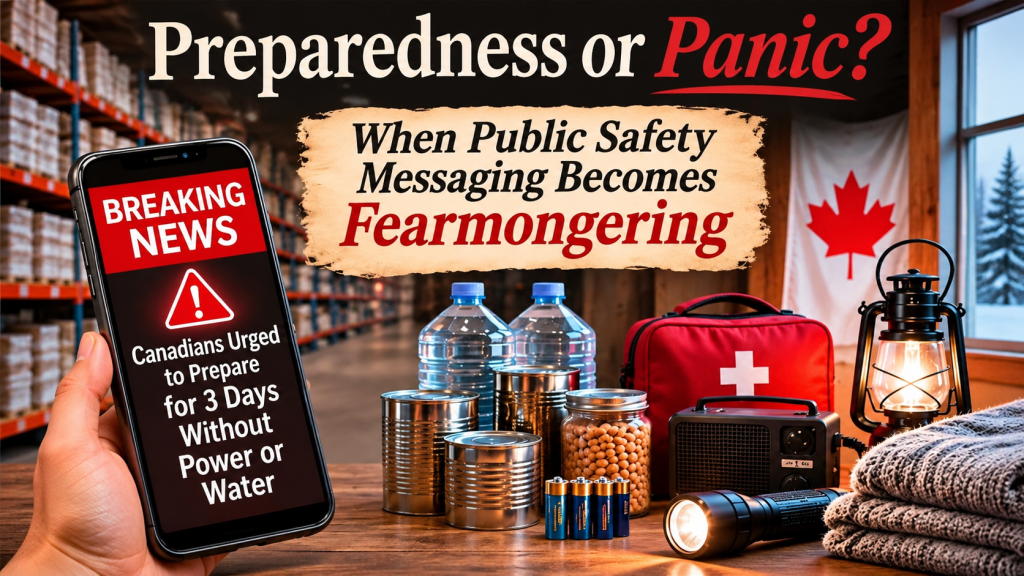
Recently, I came across a social media post declaring that Canadians were being urged to prepare for three days without electricity or water, while experts supposedly recommended seven days. The accompanying image showed a warehouse store, and the caption warned that bottled water was almost sold out.
The post was presented as breaking news.
My immediate reaction was to question whether this was a genuine public safety warning or another example of fearmongering disguised as information.
As it turns out, there is some truth behind the message. But the truth is considerably less alarming than the presentation suggests.
The Truth Behind the 72-Hour Recommendation
The Government of Canada has recommended for many years that Canadians maintain enough emergency supplies to sustain themselves for at least 72 hours.
This is standard emergency preparedness advice. It is intended to help households manage temporary disruptions caused by severe weather, power outages, floods, infrastructure failures, and other unexpected events.
It is not an announcement that Canada is about to experience a nationwide water or electricity shutdown.
Some emergency preparedness organizations recommend maintaining supplies for seven days or longer. That is also reasonable advice, particularly for households in remote communities or areas vulnerable to prolonged disruptions.
But there is an important distinction between recommending that people prepare for possible emergencies and warning that a specific emergency is imminent.
When that distinction disappears, information can become a vehicle for unnecessary fear.
The Psychology of Fear: Why These Posts Work
Fear is one of the most powerful motivators of human behaviour.
When we perceive a threat to our safety or our family’s well-being, our brains prioritize immediate responses over careful analysis.
Social media platforms can amplify this tendency.
Consider the elements of the post:
- The words BREAKING NEWS create urgency.
- The suggestion of losing essential services activates concerns about personal safety.
- The photograph of a warehouse store reinforces the impression of an emerging shortage.
- The claim that bottled water is almost sold out introduces scarcity and the fear of missing out.
Together, these elements create a compelling emotional message, even when the underlying information is routine.
The result is that people may begin reacting to the presentation rather than evaluating the evidence.
When Fear Creates the Very Problem We Are Warned About
There is another troubling dimension to this kind of messaging.
Fear can create self-fulfilling shortages.
We witnessed this during the COVID-19 pandemic when concerns about supply disruptions contributed to widespread panic buying of toilet paper, cleaning supplies, and other household necessities.
When people believe that essential products are becoming scarce, they may purchase considerably more than they need.
That behaviour can temporarily empty store shelves, reinforcing the original perception of scarcity.
Suddenly, a shortage that may not have existed becomes a real, although potentially temporary, problem.
And the cycle continues.
A photograph of empty shelves is then circulated as further evidence that something is wrong.
Are we responding to an actual emergency, or are we creating one through collective fear?
The Responsibility of Those Who Share Information
Social media has fundamentally changed how information travels.
In the past, public safety announcements generally came through identifiable government agencies, emergency management organizations, or established news outlets.
Today, virtually anyone can publish a dramatic headline and reach thousands of people within minutes.
This freedom of communication is valuable, but it also carries responsibility.
Before sharing an alarming claim, we should ask ourselves:
- Where did this information originate?
- Is the announcement genuinely new?
- Has an official authority confirmed the warning?
- Does the headline accurately represent the underlying facts?
- Is the message intended to inform us or provoke an emotional reaction?
A post can contain factually correct information while still creating an entirely misleading impression.
The problem is not always outright fabrication. Sometimes it is the selective presentation of truth.
The Commercial Value of Fear
There is also an uncomfortable economic reality behind sensationalized content.
Fear attracts attention. Attention generates engagement. And engagement can translate into advertising revenue, increased followers, and greater visibility.
Social media algorithms can reward content that provokes strong emotional reactions, whether those reactions involve anger, outrage, anxiety, or fear.
This does not mean every alarming post is deliberately deceptive or financially motivated. But the structure of the attention economy can reward sensationalism more readily than careful, balanced explanation.
A headline reading “Government Reiterates Longstanding Emergency Preparedness Advice” is unlikely to generate the same excitement as “Canadians Urged to Prepare for Days Without Power or Water.”
Yet the first headline may be considerably closer to the truth.
Preparedness Should Empower Us, Not Frighten Us
I believe emergency preparedness is important.
Keeping drinking water, non-perishable food, medications, flashlights, batteries, and other basic supplies available is a sensible precaution.
In Alberta, where winter storms and extreme temperatures can disrupt essential services, having an emergency plan is particularly reasonable.
But preparedness should be grounded in practical planning, not anxiety.
We should be able to discuss potential risks without manufacturing a sense of impending catastrophe.
We should also recognize that not everyone has the financial resources or storage space to maintain extensive emergency supplies. Encouraging gradual, affordable preparation is far more constructive than suggesting people rush to stores before everything disappears.
Responsible public safety communication should provide clarity, context, and actionable guidance. It should not leave people frightened without a clear understanding of why.
A Deeper Question: Are We Becoming Conditioned to Fear?
Perhaps the most concerning aspect of this phenomenon is its cumulative effect.
Every day, we encounter headlines warning of economic collapse, political instability, food shortages, cyberattacks, environmental disasters, and threats to our personal security.
Some of these concerns are legitimate and deserve serious attention. Others are exaggerated, stripped of context, or presented in ways designed to maximize emotional engagement.
When we are repeatedly exposed to alarming messages, we risk developing one of two responses.
We may become increasingly anxious, interpreting ordinary events as evidence of an approaching crisis.
Or we may become desensitized, eventually dismissing warnings that genuinely deserve our attention.
Neither outcome serves the public interest.
A healthy society needs people who can recognize real risks without becoming consumed by hypothetical ones.
That requires critical thinking, trustworthy institutions, responsible communication, and the willingness to question what we encounter online.
Final Thoughts: Information Should Lead to Understanding, Not Panic
The original social media post contained a legitimate recommendation: Canadians should maintain emergency supplies.
But presenting longstanding advice as breaking news, alongside an unsubstantiated suggestion of widespread water shortages, risks transforming sensible preparedness into unnecessary alarm.
There is nothing wrong with being prepared. There is something wrong with creating the impression of an imminent crisis when the evidence does not support it.
Before we share the next frightening headline, perhaps we should ask one simple question:
Am I helping people become better informed, or am I simply passing along someone else’s fear?
Because in an age when information travels faster than understanding, our ability to distinguish between genuine warnings and manufactured urgency may be one of the most important skills we possess.

