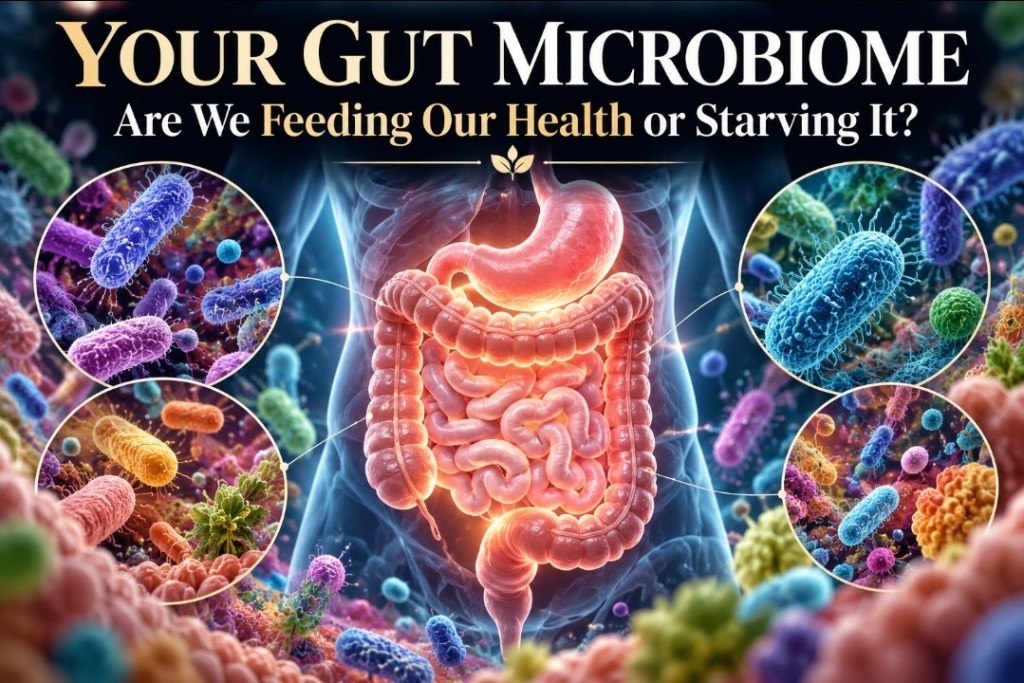
Why probiotics are only part of the story—and why the diversity of our diets may be more important than the number of bacteria in a capsule.
A Personal Note
My interest in nutrition and its relationship to human health is grounded in both formal education and personal curiosity. I studied Holistic Nutrition at the Canadian School of Natural Nutrition and earned a Nutritional Therapist Diploma from The Health Sciences Academy.
This background has shaped my appreciation for the complex relationship between nutrition, the human body and long-term health. One area I find particularly fascinating is the gut microbiome—and how the choices we make every day can influence this remarkable ecosystem within us.
We live in an age when we can purchase a supplement containing billions of beneficial bacteria, yet many of us consume diets that may not adequately nourish the microorganisms already living inside us.
We spend considerable time thinking about vitamins, protein, calories and exercise. But how often do we consider the trillions of microorganisms that inhabit our digestive systems?
These microorganisms influence digestion, metabolism, immune regulation and numerous other biological processes.
The question is not simply whether we should be taking probiotics. It is whether we are creating an environment in which our own beneficial microorganisms can thrive.
What Is the Gut Microbiome?
The human gut microbiome is an extraordinarily complex ecosystem of bacteria, viruses, fungi, archaea and other microorganisms, together with their genetic material.
Far from being passive passengers, many of these microorganisms perform essential functions.
They help break down certain dietary fibres, produce biologically active compounds, interact with our immune system and help protect against potentially harmful organisms.
Each person’s microbiome is somewhat unique, shaped by genetics, early-life experiences, diet, medications, environment and lifestyle.
Although a diverse microbiome is frequently associated with good health, diversity alone does not tell the entire story. The functions performed by microorganisms—and how they interact with their human host—are equally important.
Probiotics: Helpful Visitors, Not Necessarily Permanent Residents
One of the biggest misconceptions surrounding probiotic supplements is that swallowing billions of beneficial bacteria permanently replenishes the gut.
In most cases, probiotic organisms do not establish permanent colonies in the adult digestive tract.
Instead, they generally pass through as temporary visitors.
Research discussed by the International Scientific Association for Probiotics and Prebiotics (ISAPP) explains that many probiotic strains remain detectable for only a relatively short period after supplementation ends. Persistence varies considerably by strain and individual, and longer-term colonization can sometimes occur.
But temporary residence does not mean these organisms are useless.
During their passage, certain probiotics may:
- Interact with the intestinal lining and influence barrier function.
- Produce metabolites that affect the intestinal environment.
- Influence immune signalling.
- Compete with undesirable microorganisms.
- Help relieve particular digestive symptoms, depending on the strain.
Their benefits do not necessarily require permanent colonization.
This is an important distinction because consumers are often encouraged to select probiotics based on the number of billions of bacteria or the number of strains listed on the packaging.
A supplement containing 16 strains is not automatically better than one containing four.
Clinical benefits are strain-specific, and more bacteria do not necessarily produce better results.
The Missing Piece: Feeding the Bacteria We Already Have
If probiotics are often temporary visitors, what sustains the microorganisms that naturally inhabit our digestive systems?
Much of the answer lies in what we eat.
Certain dietary fibres and other plant compounds reach the large intestine, where resident microorganisms break them down and use them as fuel.
Some of these substances act as prebiotics—selectively supporting microorganisms associated with health benefits.
This process can produce short-chain fatty acids, including butyrate, acetate and propionate.
Butyrate is particularly important because it helps fuel cells lining the colon and contributes to intestinal barrier function and immune regulation.
In other words, our food does more than nourish our own cells.
It also helps determine which microorganisms flourish within us and what substances they produce.
Has Modern Society Lost Dietary Diversity?
Consider the typical modern diet.
Many people repeatedly consume the same small selection of foods: refined breads, processed meats, packaged snacks, sweetened beverages and convenience meals.
These foods may provide sufficient calories while offering relatively little variety in the fibres and plant compounds available to gut microorganisms.
Modern food systems have made eating more convenient, but convenience does not always translate into nutritional diversity.
Research has identified substantial differences between the gut microbiomes of people living in industrialized societies and those of populations consuming more traditional, fibre-rich diets.
These differences are influenced by multiple factors, including diet, medications, sanitation and environment. They do not mean that every traditional microbiome is healthier, but they raise important questions about the biological consequences of modern lifestyles.
Why Plant Variety Matters
A large observational research initiative known as the American Gut Project found that participants who reported eating more than 30 different types of plants weekly tended to have more diverse gut microbiomes than those eating 10 or fewer.
This finding does not establish that everyone must eat exactly 30 plants each week. Nor does it prove that greater diversity always produces better health.
However, it reinforces an important principle: dietary variety may help support microbial variety.
And variety need not be complicated.
Different vegetables, fruits, legumes, whole grains, nuts, seeds, herbs and spices all contribute different compounds to the diet.
Instead of eating the same vegetables every day, we might rotate leafy greens, root vegetables, cruciferous vegetables, berries, lentils and whole grains.
The goal is not dietary perfection.
It is to move beyond a narrow collection of familiar foods and gradually provide our intestinal ecosystem with a broader range of nutrients.
The Gut and Immune System: A Remarkable Partnership
Perhaps one of the most fascinating aspects of microbiome research is the relationship between intestinal microorganisms and immunity.
The digestive tract is home to extensive immune tissue and immune-cell populations.
This makes biological sense.
Our intestines are constantly exposed to food, microorganisms and substances from the outside world. The immune system must distinguish between harmless exposures and genuine threats.
The microbiome helps regulate this process.
Beneficial microorganisms and their metabolic products can influence immune-cell activity, support the intestinal barrier and help regulate inflammatory responses.
A healthy intestinal barrier also helps prevent unwanted substances and microorganisms from crossing into surrounding tissues.
When microbial communities are disrupted, these interactions may change.
Researchers are investigating how such disruptions contribute to inflammatory and metabolic conditions, although many associations do not yet establish direct cause and effect.
Can Diet Influence Immune Function?
A particularly interesting Stanford University study published in Cell in 2021 examined the effects of high-fibre and fermented-food diets.
Among 36 healthy adults, researchers found that a diet rich in fermented foods increased measured microbiome diversity and reduced several inflammatory markers over the study period.
The high-fibre group showed changes in microbial function and individualized immune responses, although microbial diversity did not significantly increase during the short intervention.
These findings suggest that different dietary approaches can influence the microbiome and immune system in different ways.
They do not prove that fermented foods prevent infections or treat inflammatory diseases.
Nevertheless, they demonstrate that the relationship between food, gut microorganisms and immune activity is biologically meaningful—not simply a wellness marketing concept.
Read the published research in Cell.
What About Antibiotics?
Antibiotics are among modern medicine’s most important achievements.
They treat bacterial infections that might otherwise cause serious illness or death.
However, antibiotics can also affect beneficial microorganisms alongside the bacteria they are intended to eliminate.
Depending on the antibiotic and individual circumstances, these changes may be temporary or persist for longer periods.
Some microbial populations recover relatively quickly, while others may take considerably longer to return toward their previous composition.
This is one reason responsible antibiotic prescribing is important.
It is also why probiotics have attracted attention as a possible way to reduce certain antibiotic-associated complications.
However, probiotics are not universally beneficial after antibiotics. Their effects depend on the strains used, the individual’s health and the circumstances. In some situations, particular probiotics may even delay aspects of the resident microbiome’s recovery.
The objective should never be to avoid necessary antibiotics, but to use them appropriately and support recovery through evidence-based care.
Can We Actually Rebuild a Healthy Microbiome?
The idea of rebuilding the microbiome is appealing, but scientists do not yet have a universally accepted definition of an ideal gut microbiome.
There is no single bacterial composition that every healthy person should possess.
Commercial microbiome tests can identify certain organisms, but generally cannot reliably determine which probiotic supplement a person needs.
What we can do is create conditions that support a resilient intestinal ecosystem.
Practical Ways to Support Gut Health
- Eat a greater variety of plant foods. Include different vegetables, fruits, whole grains, legumes, nuts and seeds throughout the week.
- Prioritize fibre. Oats, barley, beans, lentils and other fibre-rich foods nourish intestinal microorganisms. Increase fibre gradually, particularly if you experience IBS.
- Include fermented foods when tolerated. Yogurt with live cultures, kefir, kimchi and certain fermented vegetables may introduce live microorganisms. Not all fermented foods contain live cultures when consumed.
- Choose probiotics for a specific purpose. Look for products containing strains supported by clinical research for the condition you want to address, rather than selecting the highest bacterial count.
- Reduce reliance on nutritionally poor ultra-processed foods. Replacing some highly refined foods with fibre-rich whole foods may support both general health and the microbiome. Not all processed foods are harmful.
- Support overall health. Regular physical activity, adequate sleep and stress management may influence the gut microbiome while offering broader health benefits.
For people with IBS, dietary changes require particular care. Foods rich in fermentable carbohydrates can aggravate bloating, cramping or diarrhea in some individuals. A personalized approach is preferable to forcing dietary variety at the expense of digestive comfort.
Are We Asking Too Much of Probiotic Supplements?
The probiotic industry frequently emphasizes billions of bacteria, numerous strains and promises of digestive balance.
Yet these numbers tell us relatively little about whether a product will benefit a particular person.
Probiotics may be useful tools, but they are not substitutes for the nutritional foundations that support our resident microorganisms.
A person could consume a multi-strain probiotic every morning while continuing to eat a diet that provides very little nourishment for the broader intestinal ecosystem.
This raises a fundamental question:
Are we trying to replace beneficial bacteria with supplements while neglecting the very environment those bacteria need to flourish?
Final Thoughts: A Living Ecosystem Worth Protecting
Our gut microbiome is not simply a collection of bacteria waiting to be replenished by a capsule.
It is a living, dynamic ecosystem shaped by what we eat, how we live, the medications we take and our interactions with the world around us.
Probiotics may provide meaningful benefits for certain conditions, even when their presence is temporary.
But long-term gut health requires more than introducing microorganisms.
It requires nourishing the complex microbial communities that already exist.
Perhaps the most useful change in how we think about digestive health is this:
Instead of asking only which bacteria we should add, we should also ask what we are doing to sustain the ones we already have.
And in a society increasingly dependent on convenient, repetitive and highly refined foods, that question deserves far more attention.
Scientific Sources and Further Reading
- International Scientific Association for Probiotics and Prebiotics (ISAPP). Is Probiotic Colonization Essential?
- UCLA Health. Resetting Gut Microbiome Is a Long-Term Project.
- McDonald et al. (2018). American Gut: An Open Platform for Citizen Science Microbiome Research. mSystems.
- Wastyk et al. (2021). Gut-Microbiota-Targeted Diets Modulate Human Immune Status. Cell.
- Stanford Medicine (2021). Fermented-Food Diet Increases Microbiome Diversity, Decreases Inflammatory Proteins.
This article is intended for general education and does not replace individualized medical advice.

