The Quiet Rise of Automation Bias
When a system makes a recommendation,
something in us exhales.
A number appears.
A score is calculated.
A ranking is delivered.
The uncertainty narrows.
The burden lightens.
And sometimes… so does our vigilance.
This article is part of AI & Understanding — an ongoing exploration of how artificial intelligence intersects with human judgment, bias, ethics, and responsibility in the Age of Understanding.
The Comfort of Structure
Human beings are not only seekers of truth.
We are seekers of certainty.
When an algorithm presents a structured answer — clean, formatted, confident — it reduces ambiguity. And ambiguity is cognitively expensive.
Psychologist Daniel Kahneman describes how the mind favors cognitive ease. Information that is clear and coherent feels more reliable. It reduces mental strain. It gives us relief.
Artificial intelligence excels at this.
It delivers outputs that look:
• Organized
• Measured
• Quantified
• Decisive
It feels authoritative.
Not because it possesses wisdom.
Because it possesses format.
What Automation Bias Really Is
Automation bias is the tendency to over-trust automated systems — even when they are wrong.
It does not arise from ignorance.
It arises from subtle psychological shifts.
At first, we double-check.
Then we confirm occasionally.
Then we notice the system is “usually right.”
Then we begin to defer.
The drift is gradual.
No one announces it.
There is no dramatic surrender.
Just a quiet redistribution of attention.
Eventually, a sentence appears in meeting rooms and decision logs:
“We just followed the system.”
That sentence dissolves something.
• Agency.
• Ownership.
• Moral friction.
Friction Is Where Judgment Lives
Friction slows us down.
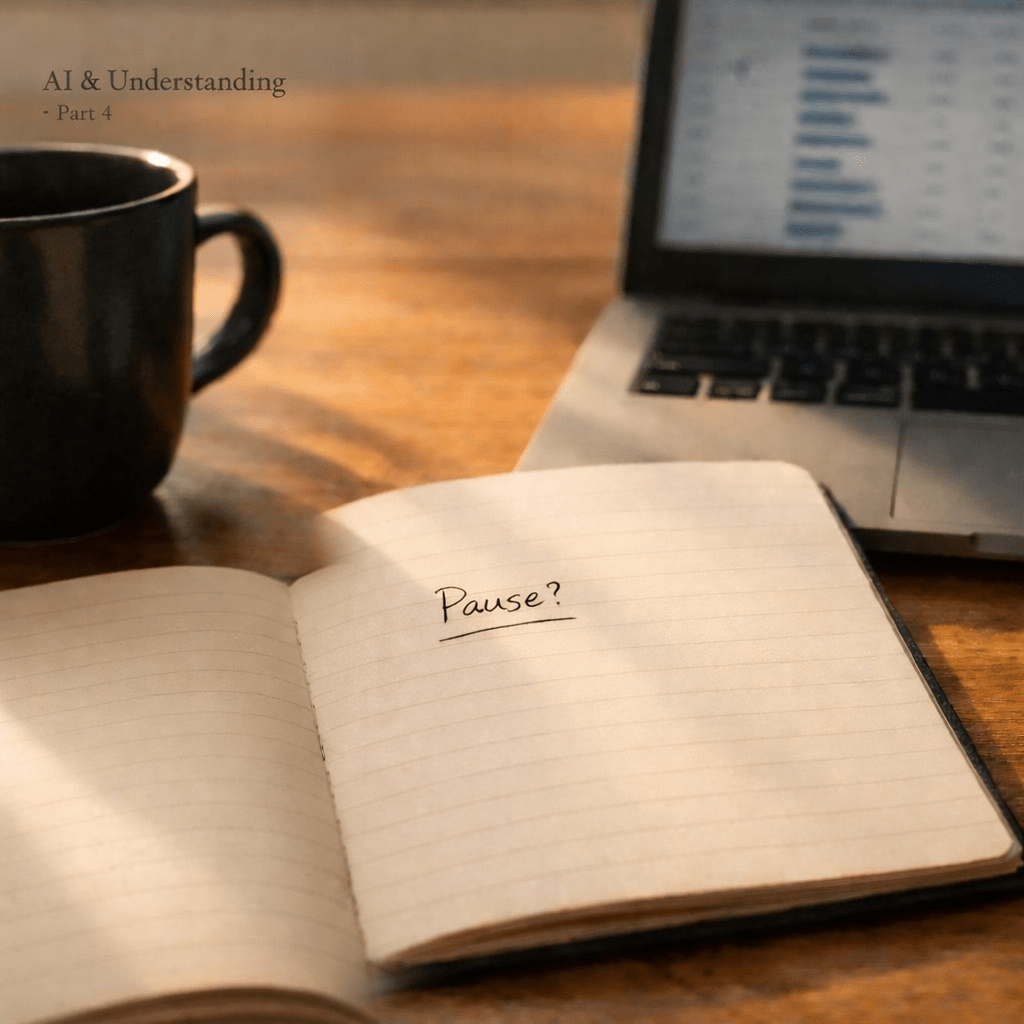
It forces pause.
Pause invites evaluation.
Evaluation invites responsibility.
Artificial intelligence removes friction.
It reduces the time between question and answer.
Between uncertainty and resolution.
Between doubt and direction.
Efficiency increases.
But when friction disappears, so does the moment in which we wrestle.
We are not anti-efficiency.
We are pro-awareness.
When decisions become easier, we interrogate them less.
And interrogation is where discernment lives.
The Subtle Relief of Delegation
There is something emotionally appealing about delegation.
If the model ranked the candidates,
if the system flagged the anomaly,
if the tool predicted the risk —
then the weight feels shared.
Or sometimes, removed.
But responsibility does not disappear.
It relocates.
When humans stop questioning automated outputs, bias does not vanish. It embeds more deeply. Errors do not evaporate. They replicate quietly.
And the most concerning part?
Automation bias does not feel unethical.
It feels modern.
Efficient.
Rational.
It feels like progress.
A Personal Observation
When I use AI tools, I notice the temptation to accept the first answer.
Not because I am careless.
Because it is easier.
Because it is fast.
Because it sounds coherent.
Ease is seductive.
But discernment requires a second look.
A pause.
A question.
Where did this come from,
What might be missing?
Does this align with what I know to be true?
These are small interruptions.
But they keep judgment active.
The Test of This Era
Artificial intelligence does not remove human judgment.
It tests whether we are willing to exercise it.
The more seamless the system becomes,
the more intentional our attention must be.
The quieter the machine grows,
the louder our discernment must remain.
In the Age of Understanding, the question is not whether machines will become more capable.
They will.
The question is whether we will remain engaged.
Because when humans stop questioning the machine,
the machine does not gain wisdom.
It simply gains silence.
Selected References
Kahneman, D. (2011). Thinking, Fast and Slow.
Skitka, L. J., Mosier, K., & Burdick, M. (1999). Does automation bias decision-making?
International Journal of Human-Computer Studies.
NIST. (2023). AI Risk Management Framework.
Research on AI-assisted clinical decision-making, JAMA (2020–2023).

 The Age of Understanding