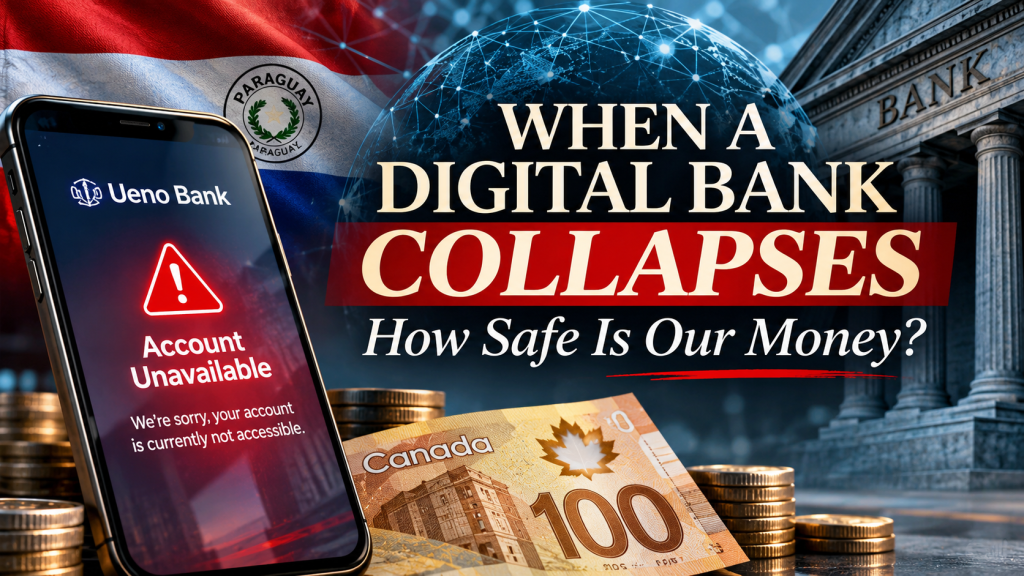
When a Digital Bank Collapses: How Safe Is Our Money?
What Paraguay’s banking crisis reveals about financial security, public trust, and our growing dependence on technology.
Imagine waking up one morning, opening your banking application, and discovering that you cannot access your money.
Your savings may still exist within the financial system, but you cannot withdraw cash, transfer funds, pay your mortgage, or purchase groceries.
For people caught in a banking crisis, this is no longer hypothetical.
In November 2026, alarming reports about Paraguay’s Ueno Bank circulated widely on social media. The reports raised serious questions about financial regulation, government accountability, and the fragility of our increasingly digital lives.
While social media quickly transformed the story into warnings of worldwide financial catastrophe, I believe the real lessons deserve a more thoughtful examination.
What Happened in Paraguay?
Reports concerning Ueno Bank described a serious financial crisis involving regulatory intervention, concerns about solvency, and disruptions affecting customers.
Some accounts also alleged questionable financial practices and political connections. Such allegations require careful verification and should not be treated as established findings simply because they appear in widely shared videos.
The distinction between a bank’s financial failure, a temporary disruption in services, and the permanent loss of customer deposits is particularly important.
These are not interchangeable events, even though sensational headlines frequently present them as though they are.
Before drawing conclusions about the full extent of the Paraguayan crisis, the details should be confirmed through official central bank announcements and independent reporting.
The Illusion of Financial Security
Most of us rarely question whether the money in our bank accounts is actually accessible.
We receive our paycheques electronically, pay bills through applications, transfer money with a few taps, and increasingly make purchases without ever handling physical currency.
Our financial lives depend on systems we cannot see, inspect, or personally control.
We trust that banks are properly managed, regulators are paying attention, and governments will intervene when necessary.
But trust and security are not the same thing.
A bank balance represents a financial claim against an institution. It is not a personal vault containing physical bills reserved exclusively for us.
Banks use deposits to finance lending and other activities while maintaining capital, liquidity, and regulatory safeguards.
This is how modern banking functions, and it generally works remarkably well.
However, the system depends on competent management, effective regulation, and public confidence.
When those safeguards fail, the consequences can be immediate.
The Difference Between Losing Money and Losing Access
One of the most important lessons from banking crises is that having money legally protected does not necessarily mean having immediate access to it.
Deposit insurance systems are designed to protect eligible customers when financial institutions fail.
However, even when deposits are protected, customers may experience disruptions while authorities arrange repayment or transfer accounts to another institution.
Consider the implications.
What happens when a family cannot purchase groceries because its debit card no longer works?
What happens when a senior cannot access pension payments?
What happens when a small business cannot pay employees or suppliers?
Even when deposits are ultimately recovered, temporary financial paralysis can create enormous hardship.
Financial security, therefore, involves two separate questions:
Is my money protected against loss?
And equally important:
Can I access my money when I need it?
We tend to focus on the first question while taking the second for granted.
Could Something Similar Happen in Canada?
Canada has a well-established banking system supported by federal regulation, capital requirements, financial supervision, and deposit insurance.
The Canada Deposit Insurance Corporation (CDIC) generally protects eligible deposits up to $100,000 per depositor, per insurance category, at each member institution.
Certain deposits held in registered accounts, joint accounts, and other eligible categories receive separate coverage.
However, not every financial product is insured.
Stocks, mutual funds, exchange-traded funds, and cryptocurrencies are not covered by CDIC deposit insurance.
Furthermore, not every institution offering financial services is necessarily a CDIC member. Provincial credit unions may operate under different deposit protection arrangements.
These distinctions are important, particularly as Canadians increasingly use online banks, financial technology platforms, and investment applications.
A banking crisis in another country does not establish that Canadian banks face an imminent collapse.
Nevertheless, strong financial institutions are not a substitute for understanding how our money is protected.
Are We Becoming Too Dependent on Digital Banking?
I find this question particularly interesting.
Technology has undoubtedly improved banking.
We can transfer money instantly, monitor transactions, pay bills from home, and conduct financial business without visiting a branch.
For many people, especially those living in rural communities or managing mobility challenges, these innovations have created meaningful accessibility.
But every technological advancement introduces new dependencies.
Consider what happens when banking applications malfunction, payment networks experience outages, telecommunications fail, or a financial institution becomes insolvent.
A society that relies almost entirely on electronic transactions can become vulnerable when those systems are interrupted.
This does not mean we should abandon digital banking or return to storing our savings under mattresses.
It means we should recognize the difference between convenience and resilience.
A resilient financial system should have safeguards, alternative payment methods, effective regulatory oversight, and mechanisms for maintaining access to essential funds during emergencies.
Technological progress should expand our choices rather than eliminate them.
When Financial Institutions Become Too Closely Connected to Political Power
Perhaps one of the most troubling aspects of any banking crisis is not simply that a financial institution fails.
Banks have failed throughout history.
What deserves closer examination is the relationship between financial institutions, political influence, and regulatory independence.
When concerns arise about political connections, the management of public funds, or the adequacy of financial supervision, those concerns deserve independent investigation.
Allegations should never be confused with proven wrongdoing.
Nevertheless, the broader principle is clear.
Financial oversight must be independent, transparent, and accountable.
When governments entrust public money to private financial institutions, citizens deserve to know what safeguards protect those funds.
When regulators identify financial irregularities, they must be empowered to act without political interference.
And when failures occur, public accountability should not depend on political affiliation or institutional influence.
Trust in financial systems is not sustained through reassuring statements alone.
It must be earned through responsible governance.
What Can Ordinary Canadians Do?
There is no need to panic or withdraw our savings because of alarming reports about a bank in another country.
But there are reasonable precautions worth considering.
- Understand your deposit protection. Confirm whether your financial institution belongs to CDIC or operates under a provincial deposit guarantee system, and understand which products qualify.
- Consider maintaining access to more than one financial institution. A secondary account can provide flexibility if your primary bank experiences a service disruption.
- Keep a modest amount of emergency cash. Not a large sum hidden at home, but enough to cover essential purchases during a short-term electronic payment disruption.
- Maintain alternative payment options. Having more than one way to pay for necessities can be useful during temporary outages.
- Be cautious about sensational financial warnings. A genuine crisis in one country does not automatically signal the collapse of the global banking system.
Financial preparedness should be based on practical risk management, not fear.
A Deeper Question: Have We Confused Convenience With Control?
There is a philosophical dimension to this story that I believe deserves consideration.
Throughout history, technological advancement has promised greater freedom, efficiency, and independence.
Yet with each new convenience, we often surrender a small measure of direct control.
We no longer need to carry cash because our phones can make payments.
We no longer need physical records because our information exists in digital systems.
We no longer need to visit banks because financial transactions can occur instantaneously.
These developments are extraordinary.
But what happens when the systems providing that convenience become unavailable?
The paradox of modern technology is that greater convenience can sometimes create greater dependence.
This does not make technology inherently dangerous.
It makes thoughtful governance, transparency, and individual preparedness increasingly important.
A truly advanced society should not merely make essential services more convenient. It should make them more reliable, accessible, and resilient.
Final Thoughts
The reports surrounding Paraguay’s Ueno Bank raise important questions about financial security and public trust.
They deserve careful investigation, not sensationalism.
A banking crisis in one country does not, by itself, establish that a worldwide financial collapse is imminent.
What such crises reveal is how quickly financial confidence can deteriorate when institutional safeguards fail.
For Canadians, the lesson is not to distrust every bank or fear digital technology.
It is to remain informed, understand our financial protections, and recognize that convenience should never be mistaken for absolute security.
Perhaps the most important question is not whether our money exists somewhere within the financial system.
It is whether the institutions entrusted with protecting it have earned the confidence we place in them.
And that is a question worth asking long before a crisis occurs.
Sources and Further Reading
- Banco Central del Paraguay — Official banking and regulatory information
- Canada Deposit Insurance Corporation — What’s Covered
- Office of the Superintendent of Financial Institutions — Canadian Financial Regulation
- Bank of Canada — Financial System and Stability
Published in The Age of Understanding — Exploring the intersection of society, technology, accountability, and critical thinking.

