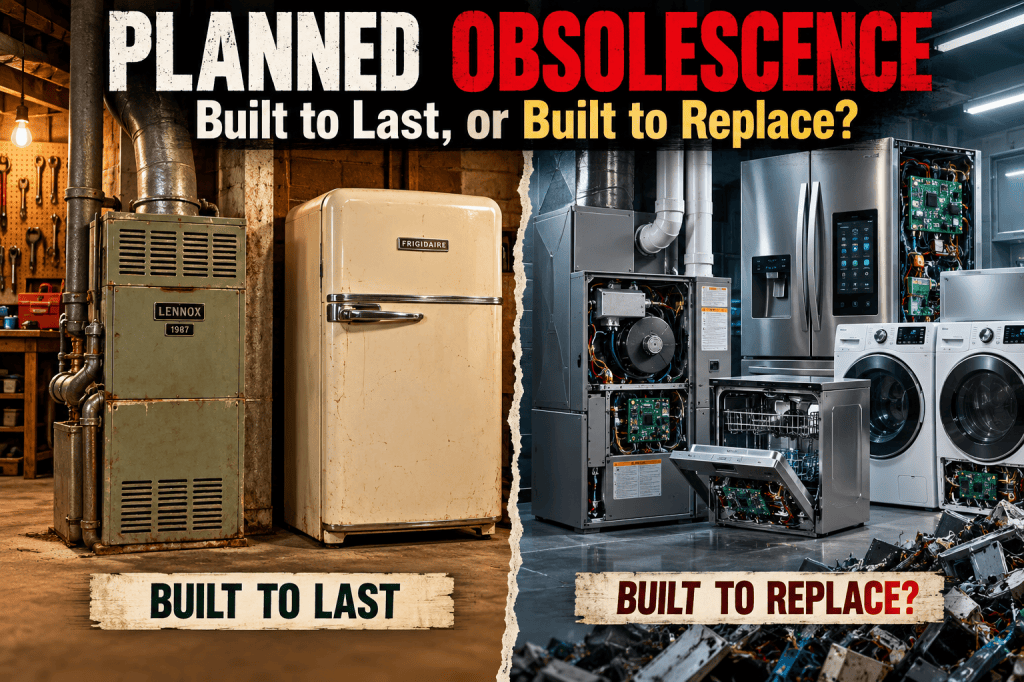
Planned Obsolescence: Why Do Our Furnaces and Appliances No Longer Last?
When efficiency improves but durability declines, who really benefits?
There was a time when purchasing a furnace, refrigerator, or washing machine was considered a long-term investment. Families expected major household equipment to serve them for decades. When something broke, a technician replaced a belt, motor, thermostat, or mechanical component, and the appliance returned to service.
Today, homeowners can face repair estimates running into hundreds or thousands of dollars, sometimes for equipment barely halfway through its expected service life.
We are told modern appliances are smarter, cleaner, and more energy-efficient. In many respects, they are. But an uncomfortable question deserves examination: Have we traded durability and repairability for technological sophistication?
What Is Planned Obsolescence?
Planned obsolescence describes a strategy in which products are deliberately designed or marketed to become obsolete, encouraging consumers to purchase replacements sooner than would otherwise be necessary.
Obsolescence can take several forms: physical components wearing out, software becoming unsupported, replacement parts disappearing, or repairs becoming so expensive that purchasing a new product appears more economical.
Importantly, a product failing prematurely does not, by itself, prove deliberate planned obsolescence. Manufacturing costs, engineering compromises, safety requirements, consumer expectations, and energy regulations can all influence product design.
Nevertheless, when a relatively inexpensive component can render an otherwise functional appliance uneconomical to repair, the consequences for consumers can resemble planned obsolescence regardless of intent.
The Modern Furnace: More Efficient, but More Complicated
Older furnaces were often comparatively straightforward mechanical systems. Some operated for 30 years or longer, although that does not establish that all older furnaces outlast modern models.
Today’s residential furnaces commonly have an estimated service life of approximately 15 to 20 years, depending on maintenance, installation, operating conditions, and equipment quality.
Modern high-efficiency furnaces also offer genuine benefits. They can extract substantially more usable heat from natural gas, reducing fuel consumption and associated emissions.
However, increased sophistication introduces additional components, potential failure points, and sometimes higher repair costs.
1. Electronically Controlled Blower Motors
Traditional furnaces commonly used permanent split capacitor (PSC) blower motors. Modern systems increasingly employ electronically commutated motors (ECMs), which offer better electrical efficiency and more sophisticated airflow control.
But ECM systems also contain electronic controls that can be costly to replace. In some installations, excessive duct resistance or restricted airflow can increase motor workload and electrical consumption.
These motors are not inherently less reliable in every application. Nevertheless, a failed electronic module may produce a considerably larger repair bill than a simple capacitor or conventional motor repair.
The consumer question: Should an energy-saving component cost so much to replace that homeowners begin considering replacement of the entire furnace?
2. Heat Exchangers and Expensive Failures
A furnace’s heat exchanger transfers combustion heat into household air while separating combustion gases from the circulating air.
Repeated heating and cooling, corrosion, manufacturing defects, and improper operating conditions can eventually damage heat exchangers.
High-efficiency condensing furnaces also use secondary heat exchangers, increasing heat recovery while introducing additional design and corrosion-management requirements.
Replacing a heat exchanger can involve substantial labour. Depending on the furnace’s age, warranty, and condition, replacement of the entire unit may become the more economical option.
A suspected cracked heat exchanger is a safety matter requiring prompt assessment by a qualified HVAC professional. It should never be treated as merely an inconvenience or a routine do-it-yourself repair.
There is insufficient evidence to conclude that modern heat exchangers universally fail sooner because manufacturers deliberately use thinner metal. But their durability, warranty coverage, and replacement cost are legitimate subjects for consumer scrutiny.
3. Proprietary Circuit Boards
Many modern furnaces rely on electronic control boards to coordinate ignition, safety monitoring, airflow, and heating cycles.
These controls can improve safety, efficiency, and diagnostics. However, specialized boards may be expensive, and compatibility between models can be limited.
If a manufacturer discontinues a particular component and no suitable replacement exists, an otherwise serviceable furnace may become difficult or impossible to repair economically.
Why should the useful life of an expensive heating system depend on whether a manufacturer continues supplying one proprietary electronic component?
4. Condensing Furnaces and Moisture Management
High-efficiency condensing furnaces recover additional heat from combustion gases, producing water condensate that is mildly acidic.
These systems require suitable drainage, corrosion-resistant components, and proper installation. Blockages, leaks, or component deterioration can create maintenance and repair problems.
Properly engineered and maintained condensing furnaces can provide reliable service. Still, their added complexity illustrates an important trade-off: improved energy performance can introduce maintenance requirements absent from simpler older designs.
And What About Our Household Appliances?
The same concerns extend beyond heating systems.
Refrigerators: When Electronics Become the Weak Link
Modern refrigerators can include electronic displays, multiple sensors, variable-speed compressors, sophisticated defrost controls, and connected features.
These innovations can improve temperature management and energy consumption. Yet they also introduce components that may require specialized diagnosis and expensive replacement.
A refrigerator whose cooling system remains functional may still require substantial repairs because of a failed electronic board, sensor, or control assembly.
Washing Machines: Repair or Replace?
Modern washing machines use electronic controls, sophisticated wash programs, water-level sensors, and advanced motor systems to improve performance and reduce water consumption.
However, failures involving bearings, electronic control assemblies, or integrated components can create costly repair decisions.
Some designs make individual components difficult to replace without purchasing larger assemblies. This can increase repair costs even when the failed part itself is relatively small.
Dishwashers and Dryers: The Cost of Complexity
Dishwashers now commonly incorporate electronic controls, multiple sensors, and sophisticated water-management systems. Dryers may include moisture sensors, electronic displays, and additional operating modes.
These features can improve convenience and performance, but the practical value depends partly on whether the equipment remains affordable to maintain and repair.
A sophisticated appliance is not necessarily a better appliance if its expected lifetime cost becomes significantly higher.
The Environmental Contradiction
Energy efficiency is important. Reducing electricity and natural gas consumption benefits household budgets and can reduce greenhouse gas emissions.
But environmental responsibility involves more than what happens while an appliance is operating.
Manufacturing new equipment requires raw materials, energy, transportation, industrial processing, and eventual waste management.
Replacing an appliance prematurely may therefore create additional environmental impacts, even when its replacement operates more efficiently.
The correct environmental comparison requires examining the entire product lifecycle, including manufacturing, operating energy, repairs, refrigerants where applicable, and disposal.
An appliance that uses less energy but must be replaced more frequently is not automatically the more environmentally responsible choice. Equally, keeping a highly inefficient appliance indefinitely is not always preferable. The answer depends on the actual numbers.
The Financial Burden on Households
Consider a hypothetical comparison.
A $6,000 furnace lasting 15 years represents $400 annually in initial purchase cost, excluding financing, maintenance, repairs, and energy consumption.
A similarly priced furnace lasting 30 years represents $200 annually in initial purchase cost.
This is not a prediction of actual furnace lifespans. It simply illustrates how durability affects ownership costs.
Energy savings might justify earlier replacement in some cases. But consumers deserve transparent information allowing them to calculate the trade-off rather than relying exclusively on marketing claims.
For families already struggling with housing, food, utilities, and other living expenses, unexpected replacement of a major appliance can become a significant financial hardship.
Canada’s Right-to-Repair Movement
Governments are increasingly recognizing that repairability is a consumer protection issue.
In November 2024, Canada enacted Bill C-244, amending the Copyright Act to permit circumvention of certain technological protection measures for diagnosis, maintenance, and repair.
However, removing some legal barriers to repair does not automatically guarantee that replacement parts will be affordable, available, or supplied for the entire useful life of a product.
The federal government has also consulted Canadians on right-to-repair policies for household appliances and consumer electronics, including durability, repairability, and interoperability.
These discussions raise a fundamental question: Should the right to repair be meaningful in practice, rather than merely permissible in law?
What Should Manufacturers and Governments Be Required to Do?
Meaningful consumer protection could include:
- Long-term parts availability: Require essential replacement parts to remain available for a reasonable period after the final sale of a product.
- Repairability ratings: Clearly disclose how easily products can be serviced and whether specialized tools or software are required.
- Transparent lifetime costs: Provide realistic information about expected service life, maintenance, and major component replacement costs.
- Independent repair access: Make diagnostic information and replacement components reasonably accessible to qualified independent technicians.
- Durability standards: Consider minimum durability requirements alongside energy efficiency standards.
- Environmental accountability: Evaluate the full lifecycle impacts of products, not simply their operating efficiency.
Consumer Experiences Deserve Attention, Too
Across appliance reviews, homeowner discussions, and HVAC technician forums, consumers describe expensive electronic repairs, discontinued parts, and frustration with equipment that fails sooner than expected.
These accounts are anecdotal evidence. They cannot establish industry-wide failure rates or prove deliberate design decisions. But repeated experiences can reveal problems worthy of systematic investigation.
We should neither dismiss consumer experiences simply because they are anecdotal nor mistake them for controlled reliability research.
Both have a place in an informed public discussion.
The Deeper Question: Who Does Progress Serve?
Technological advancement should expand human capability, improve quality of life, and reduce unnecessary burdens.
But innovation should not be judged solely by the number of features a product offers, the efficiency rating displayed on its label, or the sophistication of its electronics.
It should also be judged by whether that product remains dependable, affordable to maintain, and useful for a reasonable length of time.
When consumers must repeatedly replace expensive household equipment because repairs are inaccessible or economically unreasonable, we should question whether our economic incentives are aligned with genuine progress.
A sustainable society should not merely manufacture products that consume less energy. It should also manufacture products that deserve to last.
Final Thoughts
Modern furnaces and appliances offer genuine improvements in efficiency, convenience, and functionality. Those benefits should not be dismissed.
But neither should durability and repairability become secondary considerations.
The objective should not be to return to outdated technology. It should be to combine the best of modern engineering with the longevity, serviceability, and practical value consumers reasonably expect.
Perhaps the most revealing question we can ask manufacturers is not simply, “How efficient is your product?”
It is, “How long have you designed it to remain useful—and will you help us repair it when something goes wrong?”
Sources and Further Reading
- Natural Resources Canada — Gas Furnace Efficiency Regulations
- Carrier — How Long Does a Furnace Last?
- U.S. Department of Energy — Consumer Furnaces
- U.S. Federal Trade Commission — Nixing the Fix: Repair Restrictions
- Parliament of Canada — Bill C-244
- Innovation, Science and Economic Development Canada — Right to Repair Consultation
- Reddit HVAC Community — Planned Obsolescence Discussion (Anecdotal)

