The Age of Understanding
Canada’s equalization program is intended to promote fairness between provinces. But what happens when a province that contributes substantially to federal revenues struggles to meet the needs of its own residents? And why should Albertans be paying attention to March 31, 2029?
—
A Question of Fairness, Not Generosity
Albertans have long been proud of their contributions to Canada’s economy.
Our energy industry has generated jobs, investment, government revenues, and economic opportunities extending far beyond our provincial borders. Albertans also contribute substantial amounts to federal revenues through personal income taxes, corporate taxes, and other sources.
Yet here at home, we face serious challenges.
Emergency departments are under pressure. Patients experience lengthy waits for diagnostic imaging and surgeries. Our growing population requires additional schools, hospitals, roads, and infrastructure.
Against that backdrop, many Albertans are asking a reasonable question:
How can Alberta contribute so much to the federal government while struggling to adequately fund essential services within its own borders?
To answer that question, we need to understand Canada’s equalization program, separate fact from misconception, and examine whether the current system reflects the realities facing provinces today.
What Exactly Is Equalization?
Equalization is a federal program intended to ensure provincial governments have sufficient revenues to provide reasonably comparable public services at reasonably comparable levels of taxation.
The principle is established in Section 36(2) of the Constitution Act, 1982.
The federal government calculates each province’s capacity to raise revenue using a formula that considers several major revenue sources, including personal income taxes, business taxes, consumption taxes, property taxes, and natural resources.
Provinces whose measured fiscal capacity falls below the national standard may qualify for equalization payments.
Provinces whose capacity exceeds that standard generally do not.
Alberta has not received an equalization payment since the 1964–65 fiscal year.
However, Alberta does receive other federal transfers, including funding for health care and social programs.
That distinction is important.
Does Alberta Send Equalization Cheques to Quebec?
No. Not directly.
This is one of the most persistent misconceptions surrounding equalization.
Alberta’s provincial government does not write a cheque to Quebec or any other province.
Equalization is financed through the federal government’s general revenues, collected from Canadians across the country.
Because Alberta has historically had relatively high incomes and economic output per person, its residents and businesses have contributed substantial federal tax revenues.
Some of those federal revenues finance equalization, alongside many other federal programs and expenditures.
In other words, Alberta helps finance the federal system, but there is no separate equalization tax imposed on Albertans.
The real question is not whether Alberta writes a cheque. It is whether the broader federal fiscal arrangement adequately recognizes Alberta’s contributions and needs.
Where Does the Equalization Money Go?
For the 2026–27 fiscal year, federal equalization payments total approximately $27.2 billion.
Quebec receives the largest total allocation, approximately $13.9 billion, followed by Manitoba, Nova Scotia, and New Brunswick.
Alberta, British Columbia, and Saskatchewan receive no equalization payments.
Quebec’s larger total allocation partly reflects its much larger population compared with several other recipient provinces. The total amount received should not be confused with the amount received per resident.
And importantly, receiving equalization does not mean a province is doing something wrong.
The program is intended to address differences in provincial revenue-raising capacity, not to reward or punish particular provincial governments.
Nevertheless, its design and consequences deserve examination.
Why Do Many Albertans Question the System?
1. Alberta’s Economic Contributions Are Substantial
Alberta has historically contributed more to federal revenues than it receives in federal spending.
This net fiscal contribution is not limited to equalization. It reflects the broader relationship between federal taxes, spending, transfers, and economic activity.
Federal taxation is based on individuals’ and businesses’ circumstances, not on a requirement that every province receive back exactly what its residents contribute.
That is a fundamental feature of national taxation.
But it does not eliminate the question of whether the distribution of federal resources appropriately addresses changing provincial needs.
2. Alberta’s Economy Carries Significant Risks
Alberta’s energy industry has generated tremendous wealth, but resource-dependent revenues can also be volatile.
Oil and gas prices fluctuate. Investment rises and falls. Workers and businesses can experience substantial economic disruption.
Equalization calculations use historical revenue-capacity data, rather than responding immediately to economic conditions.
Consequently, Alberta can experience significant economic hardship without qualifying for equalization.
Canada has a separate Fiscal Stabilization Program intended to help provinces facing certain major revenue declines, but it is not equivalent to equalization.
Should federal fiscal arrangements respond more quickly when a province experiences a sudden economic downturn?
That is a question worth examining before the next renewal.
3. Equalization Does Not Directly Account for the Cost of Delivering Services
Perhaps one of the most important limitations of the equalization formula is what it does not measure.
It assesses a province’s capacity to raise revenues.
It does not directly calculate how much that province must spend to deliver public services.
Consider Alberta’s circumstances.
Rapid population growth increases demand for hospitals, schools, roads, emergency services, and other infrastructure.
These pressures do not disappear simply because a province has relatively strong revenue-generating capacity.
Other provinces also face significant costs, including aging populations, remote communities, and difficult service-delivery conditions.
The broader question is whether Canada’s fiscal arrangements adequately recognize these different pressures.
Revenue-raising capacity and actual public-service needs are not the same thing.
4. Provincial Spending Choices Are Not Part of the Equalization Formula
Quebec frequently becomes the focus of the debate because it receives the largest total allocation.
Some Albertans question why a province receiving equalization can maintain certain programs or policies that differ from those available in Alberta.
However, equalization is not determined by how much a province chooses to spend on individual programs.
Recipient provinces retain authority over their budgets and spending priorities.
This is an important principle of provincial autonomy.
It also raises questions about transparency and accountability.
Can Canadians easily understand how equalization is calculated, why allocations change, and what the broader federal fiscal system means for their province?
They should be able to.
What About Alberta’s Health Care Crisis?
This is where the discussion becomes particularly relevant to everyday Albertans.
When residents face lengthy emergency department waits, delayed surgeries, difficulty accessing family physicians, or postponed diagnostic procedures, questions about government funding become more than abstract economic debates.
They become questions about people’s health and well-being.
Alberta’s health care system is primarily a provincial responsibility, although the federal government provides substantial funding through the Canada Health Transfer.
Equalization is a separate program.
Reducing equalization payments to another province would not automatically provide additional money for Alberta’s hospitals.
That would require separate federal or provincial budget decisions.
Similarly, Alberta’s own decisions about taxation, spending, infrastructure, and health care priorities directly influence the resources available to its health system.
A meaningful discussion about fiscal fairness must therefore examine both federal arrangements and provincial spending decisions.
We should be asking whether the federal government adequately recognizes Alberta’s needs while also asking whether Alberta’s government is making the investments necessary to address those needs.
The two questions are not mutually exclusive.
March 31, 2029: A Deadline Albertans Should Know About
There is an important date approaching that deserves far more public attention.
The current federal equalization legislation is scheduled for renewal before March 31, 2029.
The existing statutory authority for the program runs through the 2028–29 fiscal year. Parliament must address the program’s legislative continuation before the next fiscal period begins on April 1, 2029.
This is not an automatic constitutional renegotiation, nor does it mean equalization will necessarily end.
The constitutional commitment to equalization is separate from the legislation establishing its detailed formula and payments.
However, the renewal provides an opportunity to examine how the program operates.
It is a chance to ask:
– Does the formula adequately reflect economic volatility?
– Should the cost of providing public services receive greater consideration?
– Are rapidly growing provinces facing pressures that existing federal transfers do not adequately address?
– Is the treatment of natural resource revenues appropriate?
– Should there be greater transparency about provincial contributions to federal revenues and federal spending?
– What changes, if any, would make the system more responsive without undermining comparable public services across Canada?
These are not questions that should be left exclusively to politicians or constitutional experts.
They affect Canadians in every province.
And Albertans have a legitimate interest in understanding the choices being made on their behalf.
What Would Happen if Equalization Were Reduced or Changed?
Any reform would involve trade-offs.
Reducing equalization could lower federal expenditures, but it could also reduce the revenues available to recipient provinces for public services.
Changing the treatment of resource revenues might alter provincial entitlements.
Adding service-delivery costs to the formula could benefit some provinces while changing the distribution of payments to others.
A separate stabilization mechanism could provide more timely assistance during economic downturns without fundamentally changing equalization.
There is no guarantee that changing equalization would increase Alberta’s federal transfers or reduce federal taxes paid by Albertans.
That would depend on the precise reform and accompanying government decisions.
Understanding those consequences is essential to a serious discussion.
Equalization Was Intended to Create Fairness. Is It Keeping Pace With Canada?
Canada has changed substantially since equalization was introduced in 1957.
Provincial economies have evolved. Populations have shifted. Infrastructure demands have grown. Health care costs have increased.
The economic realities facing provinces today are not identical to those of previous generations.
A formula that was designed to address disparities in revenue-raising capacity should be periodically examined to determine whether it continues to achieve its intended purpose.
That does not require abandoning the principle of helping Canadians access comparable public services.
Nor does it require portraying recipient provinces as undeserving.
It requires asking whether the system is sufficiently transparent, responsive, and suited to contemporary economic realities.
My Closing Thoughts
I believe Canadians should care about the well-being of people across this country, regardless of provincial boundaries.
A child in Nova Scotia deserves access to quality health care just as much as a child in Alberta.
A senior in Quebec deserves dignity and appropriate medical treatment just as much as a senior in Saskatchewan.
But I also believe that fairness requires accountability, transparency, and a willingness to examine policies that may no longer adequately reflect the circumstances they were designed to address.
Alberta’s contributions to Canada’s economy deserve recognition.
So do the pressures facing its residents.
The question is not whether Alberta should help support the rest of Canada. The question is whether Canada’s federal fiscal arrangements fairly balance that responsibility with Alberta’s own needs.
With the equalization program approaching its March 31, 2029 legislative deadline, now is an appropriate time for Canadians to become informed and participate in that discussion.
Because fairness should not be assumed simply because a program was designed with fairness in mind.
It should be examined, explained, and continually evaluated.
—
Sources and Further Reading
1. “Department of Finance Canada — Equalization Program” (https://www.canada.ca/en/department-finance/programs/federal-transfers/equalization.html)
2. “Department of Finance Canada — Major Federal Transfers” (https://www.canada.ca/en/department-finance/programs/federal-transfers/major-federal-transfers.html)
3. “Constitution Act, 1982 — Section 36” (https://laws-lois.justice.gc.ca/eng/const/page-12.html)
4. “Federal-Provincial Fiscal Arrangements Act” (https://laws-lois.justice.gc.ca/eng/acts/F-8/)
The Age of Understanding — Exploring complex issues with curiosity, evidence, and conscience.
Category: Canadian Politics & Public Policy
-
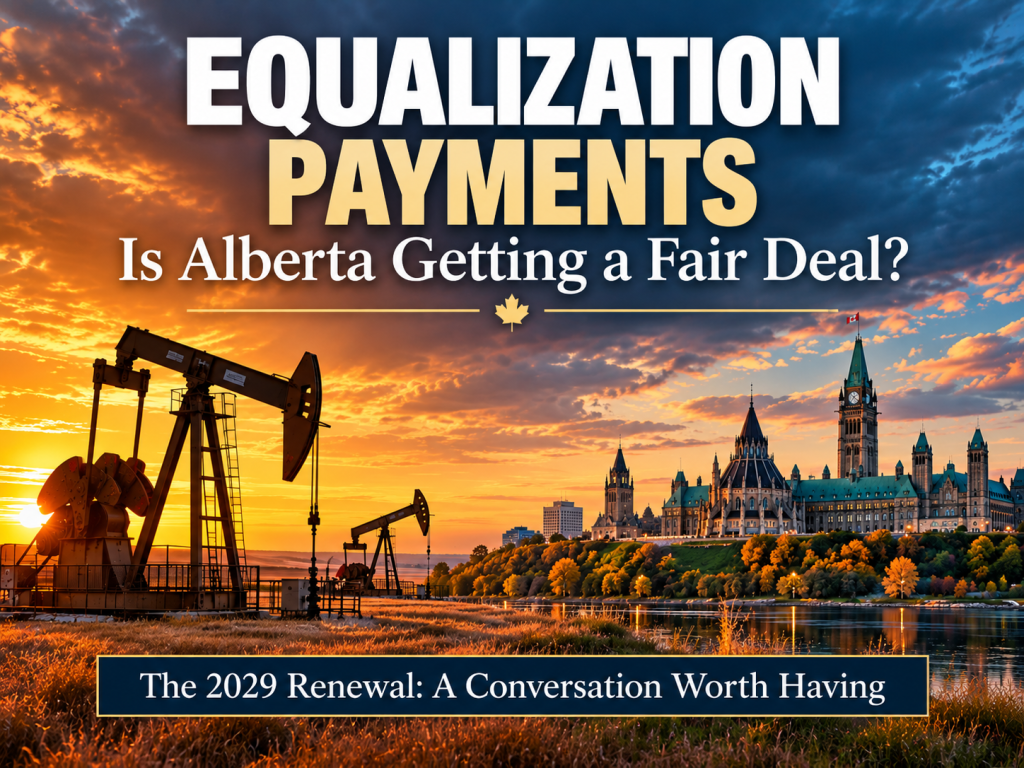
Equalization Payments: Is Alberta Getting a Fair Deal?

